Home | Call Us 978.327.5340
Nexcelom Bioscience     Cellometer Simply Counted
Learn More

Simple, Fast and Consistent Determination of Yeast Viability using Oxonol

Yeast
Cellometer Vision
Schedule an Online Demo
Contact Us
Download PDF

Introduction

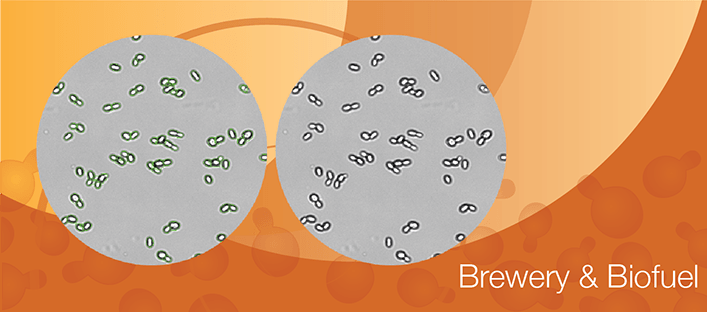
Brightfield image of yeast cells acquired by Cellometer Vision
Brightfield image of yeast cells
acquired by Cellometer Vision


Fluorescent image of oxonol stained yeast
Fluorescent image of oxonol
stained yeast

Cellometer Vision incorporates image-based cell counting and fluorescence detection in a compact and easy-to-use instrument for generating yeast count and viability measurements. By providing more consistent results with less effort than manual methods, Cellometer Vision is ideal for use in fermentation processes in the brewing and bio fuel industries.

While a variety of methods exist to assess yeast viability, each one has specific drawbacks that make it less than ideal for use in a production environment requiring consistent and accurate results. Although culture-based methods can be used to determine yeast viability, staining techniques and direct observation are more commonly used in fermentation processes. The most widely used stain in the brewing industry, for example, is methylene blue. Live cells exclude or reduce the dye while dead cells stain blue. Manual counting of both live and dead cells on a hemacytometer is performed under a microscope to determine concentration and viability, but is a time-consuming and labor intensive process. More importantly, the methylene blue assay has been reported to produce inconsistent results and analysis can be subjective. Errors in cell counting, viability measurements, and data recording ultimately lead to inconsistent fermentation performance.

Use of the fluorescent dye oxonol (bis-(1,3-dibutylbarbituric acid)trimethine oxonol(DiBAC4(3)), an anionic membrane potential dye that preferentially stains dead cells, has been reported as a reliable and accurate method to assess yeast viability. Cellometer Vision automatically counts total and oxonol positive dead yeast cells addressing the need for simple, rapid counting and viability testing of yeast cells. By capturing both brightfield and fluorescent images from the same sample, the software determines total cell count and concentration and determines viability, typically in less than 60 seconds.

Counting results box
Counting results box displays brightfield and fluorescent cell count, mean size,
concentration & viability percentage.


Method

Running Assay:
  1. Take 20µl of yeast sample and mix with oxonol to obtain a final concentration of 1.5µg/ml and mix well by pipetting up and down.
  2. Load 20µL of sample into the disposable counting chamber.
  3. Allow cells to settle in chamber for one minute.
  4. Insert chamber into Cellometer Vision.
  5. Select assay from drop-down menu.
  6. Enter sample ID manually or scan in with barcode reader.
  7. Preview cell images and click 'Count' to begin analysis.
  8. Review images and counting results on-screen.
  9. Count, concentration, and viability data can be automatically saved or printed.

Results

Total counted yeast cells are indicated on-screen by green circles in the brightfield image (Figure 1). Dead cells stained with oxonol are indicated as fluorescent positive green circles in the fluorescent image (Figure 2). Cellometer software automatically calculates cell count, concentration, mean cell size, and viability and displays results. Cell size distribution histograms (Figure 6), data files, and cell images can be instantly created, and saved for further analysis or for quality control record keeping.

Total counted cells
Figure 1. Total counted yeast
cells are indicated on-screen
by green circles
Oxonol stained cells
Figure 2. Fluorescent image
showing oxonol stained dead
cells (green circles), and
live cells (red circles)

Results
Figure 3. Total yeast count and concentration (BrightField), dead cell concentration
(Fluorescence) and viability percentage are displayed on-screen immediately
after analysis. Mean diameter of cells is also reported.

Yeast Type
Viability %
A
88.5
B
89.5
C
73.2
D
78.7
E
77.6
F
5.1
Figure 4. Yeast viability results for a variety of strains of commercially
available dry yeast tested with the Cellometer Vision after rehydration

 
Viability
Concentration
Mean Size
Yeast type E sample 1
Mean(n=6)
99.6
9.14X10⁶
4.9
CV
0.2%
5.4%
2.4%
Yeast type E sample 2
Mean(n=7)
85.3
5.92X10⁶
5.4
CV
4.1%
13.3%
1.7%
Yeast type E sample 3
Mean(n=7)
79.6
1.2X10⁷
5.4
CV
4.2%
8.8%
1.8%
Figure 5. Yeast viability results for rehydrated yeast at various time points CV = coefficient of variation

Cell size histograms are generated instantly
Figure 6. Individual cell size measurements are used to calculate mean cell size, and
generate cell size histograms
Schedule an Online Demo
Contact Us
Download PDF